

This post is a natural successor to the previous one on The Power of (Almost) Now.
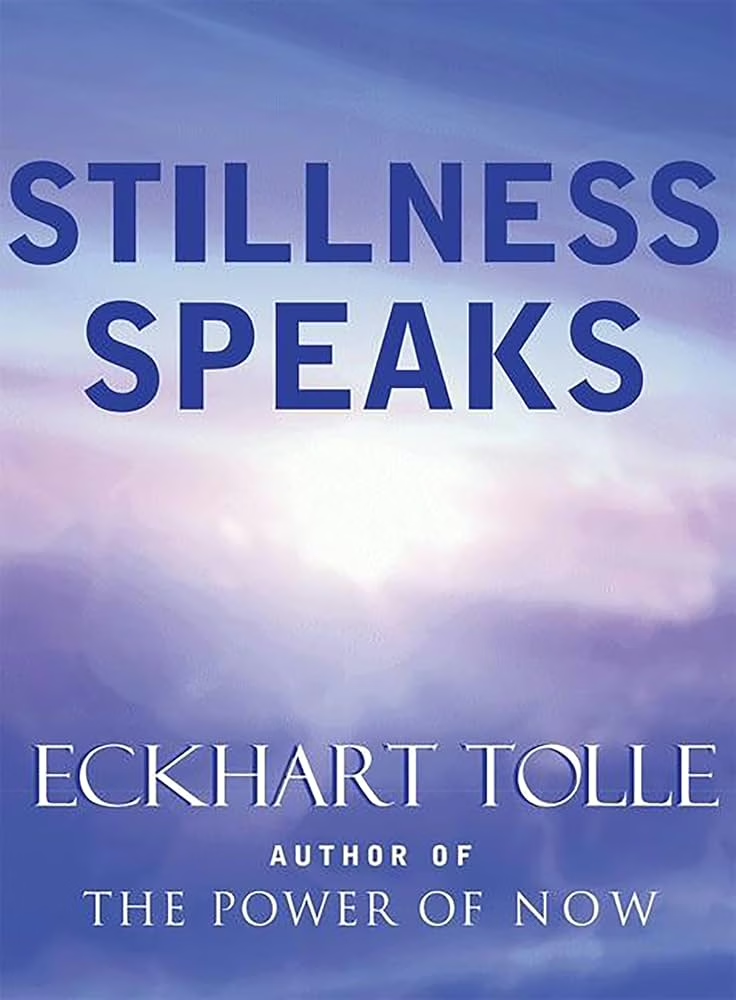
This is one of my favourite books because it effortlessly does what it promises – puts me directly in touch with stillness within. The very first sutra gets to the heart straightaway:
When you lose touch with inner stillness, you lose touch with yourself. When you lose touch with yourself, you lose yourself in the world.
Your innermost sense of self, of who you are, is inseparable from stillness. This is the I Am that is deeper than name and form.
I find this single sutra contains the whole teaching — like a hologram, each part of the book contains the whole.
The above sutra points to the true nature of our self, Stillness. We refer to this stillness in everyday language as I Am. They are the same. However, when we lose touch with stillness, we mistake ourselves for a limited, separate self, running around, getting lost in the world, and seem to have a whole host of apparent problems to solve.
The rest of the book traces how we lose touch with our innermost sense of self, and how we might return home.
The title itself is apt because it is not a clever oxymoronic juxtaposition of opposites for effect. It points to the source of the words in the book and, further, to the source of all life.
How we align ourselves to this source is our life’s inner purpose, and the extent to which we manage it is a measure of our suffering or the lack of it.
When I tell people I meditate, they ask me what method I follow. I have not learnt any particular method, and I don’t practice anything, though I have tried many different things. I don’t watch my breath, I don’t focus on an image, and I don’t have a method like Vipassana or TM. I just sit quietly and allow the mind to drop like an anchor by its own weight, and it does.
After I get lost in the world, so to speak, for a few days, as it tends to happen every once in a while, when I return to sit quietly, it takes a while for the mind to settle down, but eventually it does. With a few days of consistently sitting quietly, it hardly takes a moment to slip into this silence, and for the anchor to drop quite rapidly.
What made me take to this approach intuitively? I can trace three influences.
The first was J Krishnamurti. He said:
In the light of silence, all problems are dissolved.
Of all his teachings, this one sentence holds the key for me. The rest of his teachings are really an expansion on the nature of the mind, how it struggles to be silent and how effort perpetuates the separate self. Years of studying his teachings naturally made me gravitate towards something that was not a how. Sitting quietly did not seem to involve any kind of practice or method, and that appealed to me right away.
Having studied at Rishi Valley School, I was fortunate to have had the experience of watching the sunset quietly for fifteen minutes every evening — we called it Asthachal — looking out towards three of the oldest hills in that region (one of them was Rishi Konda, after which the school was named).
I would often sit at Asthachal a bit longer after everyone left — it was one of my favourite moments at the school. The valley itself has a very special silence that is palpable immediately. The ground for sitting quietly without much effort was laid there during my growing years. And my lifelong love for the hills also comes from the four years I spent in that beautiful valley. (Why, oh why, do I not live in the hills still?)
The second influence was Ramana Maharshi’s pithy phrase :
Summa Iru
It translates from Tamil as Be Silent. This was his highest teaching, and he embodied it by transmitting his teaching through silence much of the time. Summa Iru also means Just Be. Again, these two words spoke to me directly and made instant sense. If I already found it easy to sit quietly, and if Bhagwan said that is the highest teaching, why would I not do that?
The third influence was Nisargadatta Maharaj’s words:
A quiet mind is all you need. All else will happen rightly, once your mind is quiet.
All of them were pointing in the same direction. Luckily, I found sitting quietly came easily to me, so that became my ‘practice’ if one can call it that.
Later, I would discover the liberating power of yoga meditations of the Direct Path in dissolving the sense of separation that continues to reside in the body even after experiencing stillness within and understanding the true nature of the Self. That remains a work in progress.
Returning to Eckhart Tolle’s book, here is one sutra from each of the remaining nine chapters that spoke to me most directly:
Chapter Two:
The human condition: lost in thought.
This ties back to the first quote. This is how we get lost – in thought. So the way out is not more thinking but Awareness.
As a lifelong overthinker, I cannot think of anything else more pertinent to my experience.
Chapter Three:
The mind is increasingly looking not only for food for thought; it is looking for its identity, its sense of self. This is how the ego comes into existence and continuously re-creates itself.
Sitting quietly, I have found it is fairly easy to see that the ego is non-existent once you start looking for it. That’s not a difficult discovery to make. However, knowing that does not prevent it from springing back into action once I start interacting with others. It might also disguise itself as wisdom in the form of a blog. How would one know the difference? The rabbit hole goes deep, apparently.
Chapter Four:
This one moment — Now — is the only thing you never escape from, the one constant factor in your life. No matter what happens, no matter how much your life changes, one thing is certain: it’s always Now.
The security we seek is not to be found in the vicissitudes of time, but in the one timeless reality.
Of course, at a pragmatic level, resting in the Now is challenging, and I find it useful to focus on the Almost Now!
Chapter Five:
The Now is inseparable from who you are at the deepest level.
With this sutra, we get a sense that we have a deeper identity than the separate self that we mistake ourselves to be, and the portal to that identity is the Now.
Chapter Six:
Surrender comes when you no longer ask, “Why is this happening to me?”
Ah, what a gem this one is. After a few years of living in this world, it becomes clear that suffering arises from a non-acceptance of what is. Yet, when we are hit by one crisis after another in our lives, it’s natural to ask: Why me?
The best answer I have found to that question is: Why not me?
Suffering from ignorance is our common human experience — what varies are the specifics of our contexts. Counter-intuitively, the acceptance of what feels unacceptable is the key to peace. Forgiveness is another aspect of dropping the need for the world to be different from what it is.
Chapter Seven:
Notice how present a flower is, how surrendered to life.
Here we have another portal to stillness: nature. Whenever I am in the hills, I can’t help but wonder how long they have stood there, witness to so much change over millions of years, and how small our troubles are. Truly, we live largely petty lives with petty problems.
One of the most striking lessons from the Covid-19 pandemic was how swiftly nature moved in to restore harmony when human activity was reduced. It also made me wonder how quiet the world must have been not too long ago.
I have a friend who grows a garden on her terrace, and she generously sends a photo occasionally of her latest morning bloom, which always brightens my mood.
My mother had a green thumb, too — everything she touched grew, and how!
In contrast, the only three plants I have tried to grow withered away, and I have yet to try again.
Chapter Eight:
Human interaction can be hell. Or it can be a great spiritual practice.
Honestly, at this point, I am happy to be a hermit of sorts. I do what little human interaction I cannot avoid; otherwise, I am happy to remain in solitude. Having said that, I realise that the only way to test whatever understanding one might have is through human interaction. It is all very well to be wise in one’s cave; how much it has been truly integrated is revealed only in the company of others. Having said that, I am happy to remain deluded for a while though!
Chapter Nine:
Death is not the opposite of Life. Life has no opposite. The opposite of death is birth. Life is eternal.
There we have it: the phenomenon of individual body-minds passing away while our true identity remains birthless and deathless. I cannot think of anything more important than to come to this understanding and rest in it without a shred of doubt.
Chapter Ten:
The inner alignment with Now is the end of Suffering.
Normally, we think of ourselves as separate individuals who find that occasional silence inside us through meditation as a refuge and healing space from life experiences that scar us. What is pointed out here is that reality is inverted — we ARE the indestructible Stillness, within which there is an appearance of individuals who seem separate, and seem to get hurt. The world of relationships and work is not real; it is transient, ever-changing. Wrongful identification with it — and attempts to find peace and happiness in that appearance — is the cause of our suffering, and a realignment with the Now ends the attachment to the false. Rather, we just return home, a placeless place we never left.
Self-enquiry leads to an important discovery: Awareness (or Stillness), the true essence of our self, that’s utterly untouched by experience.
Rupert Spira uses a wonderful analogy to illustrate this understanding: just as a bird does not leave a trail in the sky as it flies, our experiences (however painful or ecstatic) leave no trace whatsoever on Awareness. This is directly verifiable.
Direct contact with Awareness through meditation changes the texture of suffering completely — it is just not as powerful anymore because you have touched that which is indestructible, and you now know that in essence you just cannot be broken, whatever one’s life circumstances might be. You might still fret out of habit when things don’t go your way, and there will be pain and discomfort, but it won’t carry the previous sting any more.
The more I sit quietly, the more alignment I find when faced with challenging life circumstances, and it creates a pause which embodies freedom.
I will end this already quote-heavy piece with the words of Viktor Frankl:
Between stimulus and response there is a space. In that space is our power to choose our response. In our response lies our growth and our freedom.