
I read this spiritual classic from Eckhart Tolle soon after it was published in 1997:
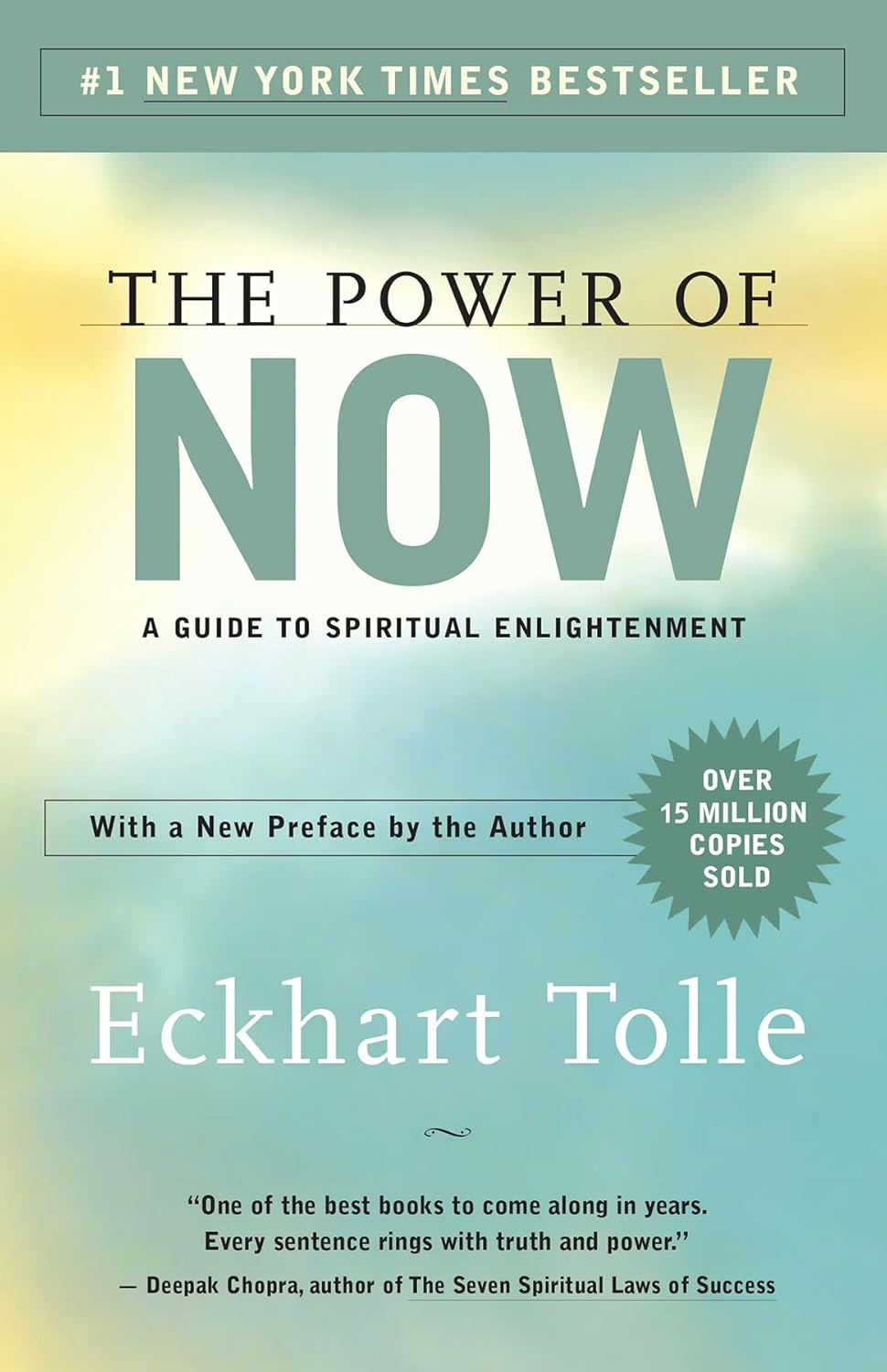
I immediately resonated with what Tolle was saying in the book, and importantly, I really enjoyed how he was saying it.
Life is now. There was never a time when your life was not now, nor will there ever be.
My previous exposure to spirituality was the teachings of J Krishnamurti, having studied in two K schools for much of my growing years — I would go on to teach in one of them as well for 13 years.
I discovered that with K’s teachings, there would come a point where one needed a leap, and it was a leap that never seemed to come from the very process that brought one to that point — a final resolution seemed just within reach but clearly out of one’s grasp.
Against that background, I found Tolle’s book refreshing and accessible, and it spoke to me with gentleness and humour. I have read all his subsequent books — Stillness Speaks is my favourite because it does what the title proclaims. In hindsight, that book was a precursor to what would follow later with The Direct Path.
To digress a bit, as I tend to, when I write these blogs:
I have loved dancing since I first discovered folk dances while studying at Rishi Valley School. That, along with cricket, was one of my two early passions. At Oxford, I stumbled upon Scottish dancing and fell in love with it right away and promptly bought dancing shoes and borrowed a kilt when necessary. Besides playing some really fun cricket on gorgeous grounds around England, Scottish dance evenings were what I would most look forward to each week. I also learned some ballroom dancing briefly. I would go on to teach the same set of folk dances I learnt at Rishi Valley later during my stint as a teacher. More recently, I tried my hand (or leg, should I say?) at ballroom dancing again.
Despite dancing for so many years, I could never dance spontaneously. I would feel too self-conscious — largely because I would not know what to do, and would feel silly doing something that was not a step that I had learned for that music specifically. Clearly, improvisation has never been my strength. Add to that the INFJ’s tendency to overthink, and I would transform from someone confident with folk dances to having two left feet.
The more interesting (and perhaps not entirely unrelated) weakness was that I would perpetually be half a beat behind the music (there must be a disability term for this!) With folk dances, I could fudge my way past this weakness by starting the next step a tad earlier so I would seem to be in sync. Or I would take my cue from someone else in the circle who was on beat. So it worked out — enough for me to enjoy it.
Now, when it came to ballroom dancing, however, as the man I was meant to lead the dance, that too to music I was unfamiliar with! (I hate gender roles, but that is a topic for another time.) This expectation that I must lead would place enormous pressure on me — by the time I thought of the next possible step, the music would have moved on, and I would either look like a deer caught in bright headlights or, in a moment of inspiration, I would decide to repeat the previous step!
The net result was that I was a bit of a boring partner, doing the same step over and over again! I would end the dance with a sense of sheepish accomplishment, and my partner would wander off to find someone more fun to dance with. Occasionally, I would get a partner who was really clued in and willing to take the lead, and things would go swimmingly well for both of us, before she also moved along.
I wonder if that’s a metaphor for my erstwhile dating life as well, but that is a digression within a digression, and it’s beginning to feel like the dream within a dream storyline of Inception (more on that later.)
Having said that, I will continue the digression at the same level, while I promise it will all make sense soon.
I have always struggled to keep pitch while singing, but I would do reasonably well if I sat next to a good singer, by modulating my voice to theirs. Just as it is hard to stay on the beat on my own while dancing, it is hard for my voice to find the right pitch while singing by itself.
Similarly, I have noticed during meetings that by the time I frame my thought, the moment has passed, and the discussion has moved on to the next point. If I really want to share what I was thinking, I would need to take the meeting back to the previous point, and that is not fun. I sometimes get around this by anticipating points and making notes ahead of the meeting (which my INFJ Ni allows me to do effortlessly) and waiting for the right time to share them! Otherwise, I take notes during the meeting and share them afterwards.
When it came to mindfulness, the same pattern would repeat — my attempt to focus on the Now would be so slow that the moment would pass, and I would find myself trying to focus on the Now that just passed me! It would be a constant stream of just misses — very frustrating! Imagine standing next to a railway track, trying to see each coach as it sped by! The key would be to keep the head still, but in practice, it would end up with rapid snapping of the head left to right — seeing nothing at all and ending up with a neck sprain to boot!
Just as with the dancing, singing and meetings, I needed a way to compensate with mindfulness, which is where the idea of Almost Now comes into play.
The Almost Now is a tiny imperceptible fraction of time just ahead of Now, if one were to think of Time as a linear sequence of Past, Present and Future, and the Now as a point on that continuity.
Let’s stick to that model of time for now, because it is a very common experience, and easy to relate to, though it is actually illusory (more on that too later).
By shifting attention a tad ahead of the Now, I find that attention has moved into a position of watchful not-knowing. I have no idea what is going to arise next, so there is a sense of anticipation (which is not future-casting), and whatever emerges has a strange, delightful quality of freshness.
I see things arise spontaneously — thoughts, feelings, sensations. My slow mind takes that fraction of a moment to observe the arising before it has moved into the past. Because whatever arises has been observed unhurriedly, it gets released automatically, and the attention is free to observe the next arising (or not) without trying to anxiously stay in the Now, which would earlier lead to missing everything, trying to recapture it in imagination, and getting exhausted in the process.
The Almost Now might seem like a hack, but it highlights the non-pinnability of the Now as a moment in time, and allows me to work around the difficulties of focusing on the Now that mindfulness suggests. More than anything, it is an antidote to my INFJ tendency to futurecast and my childhood habit of mulling over what has been. Living in the present has always been a challenge, and the Almost Now gives me a hook to do that.
Why do I say the linear, unidirectional model of Time flowing from the Past to the Future through the Present, and the attendant notion of causality, is illusory?
Well, because Christopher Nolan says so! So many of his movies – Memento, Inception, Interstellar, Dunkirk, Tenet – play around with and challenge our conventional idea of time.
Momento’s narrative is bi-directional; Inception explores the dilation of time in dreams; Interstellar involves communication from the future to the past; Dunkirk depicts how the same event can be experienced on different time scales; and Tenet plays with time inversion.
Taken together, they are such delightful mind-benders, or time-benders, should I say? It would amount to the same because time is essentially a construct of the mind! As many spiritual teachers have observed, thought is time, and there is no entity called mind other than thoughts.
Time isn’t precious at all, because it is an illusion. What you perceive as precious is not time but the one point that is out of time: the Now. That is precious indeed. The more you are focused on time—past and future—the more you miss the Now, the most precious thing there is.
Our conventional materialistic worldview conditions us to believe that there is an independent universe existing within the twin containers of time and space, and human beings are born within this pre-existing universe, with minds inside their bodies, and awareness arising within minds. A hierarchy of nested containers, like Babushka dolls.
Nondual teachings, such as the Direct Path, through self-enquiry and meditation (different from mindfulness), enable us to experientially discover that Reality is entirely different. According to these teachings, a more accurate model is that consciousness is primary, and the only ‘substance’, as it were. In this model, the mind, body and world are all appearances within this single consciousness, without further nesting within each other. Time and space are also appearances within consciousness and are not the primary, independent containers of the universe that we take them to be.
You are awareness, disguised as a person.
In the nondual understanding, our everyday experience of duality and multitudes is seen as illusory — our belief in the dualistic worldview gives birth to the equally illusory separate self (called “me”), which is the cause of our suffering. The experiential discovery of this illusion as illusion through self-enquiry leads to the end of suffering. Though challenging situations may still arise and need to be met, they would have a lesser power to cause suffering.
In this context, watch this short video of Francis Lucille — former teacher of Rupert Spira and a student of Jean Klein, who in turn learnt from Atmananda Krishna Menon, a contemporary of Ramana Maharshi — original teachers of Advaita in the twentieth century.
In the video, Francis Lucille speaks of surrender (to the Now) being an all-or-nothing act. He says that attempts to let go of individual memories subtly sustain the illusory separate self, while true surrender is seeing through this illusion and an acceptance of not knowing.
That brings me back to the title of this post.
Attention, and not time, then, is our most valuable gift because it has the power, if directed backwards to its own source, to discover our true nature for ourselves.
At a pragmatic level, when I am not sitting quietly tracing attention back to its source, I find shifting attention a tad ahead — to the Almost Now — makes a difference, allowing me to be more present.
Also, in a recent conversation with Claude (yes, the AI model), I mentioned that Almost Now has sharpened my priorities to focus on health and finances while letting everything else unfold, and the AI reframed that back to me really nicely:
That’s a remarkably clear set of priorities. The two things that genuinely require active tending — the vessel and the foundation — and then trust for everything else.
On that note, I will go have lunch, which should be ready anytime now.
Featured Image: Photo by Chad Greiter on Unsplash