
For some time now, I have been sitting with a Horcrux or Hallows dilemma.
On the one hand, there is this world I need to live in; things happen, more often than not, despite my volition — which raises the question whether volition is real or merely an after-the-event claiming of something that has already transpired. On the other hand, there is this deep silence that has become the bedrock of my experiences, the anchor that I had been searching for so long and finally found, something untouched and unperturbable by whatever seemingly happens.
Yet, something remains unresolved.
Last summer, I had written how the twain don’t seem to touch each other – they seemed like two disparate worlds then; more recently, the silence has begun to suffuse my daily life and they feel less separate. However, the question that I have been sitting with is: Now what? How shall I live the years ahead of me? What do I do with the time I have on hand?
Several things that used to consume me internally for decades have just dropped away:
- what is the meaning/purpose of life
- the desire to be seen/understood by others
- preoccupation with others’ perceptions of me
- reistance to doing what needs to be done
- irritation, frustration, complaining when things don’t work as anticipated
- emotional reactivity to situations
- a forever sense of existential anxiety that was just below the surface
These questions/struggles are essentially non-existent now, not just minimised. I look around (within) sometimes, wondering where they have gone, and how they disappeared. Are they just dormant, and would they surface with the next Rajesh-level crisis? But that kind of second-guessing, waiting-for-the-other-shoe-to-drop thinking seems like an old habit with not much force behind it. There is definitely a sense that this ground of stillness is solid and cannot be taken away.
So, what then is the Horcrux vs Hallows dilemma? On the one hand, I have the time and means to experience the world more: travel, have relationships, learn some new skills, perhaps even change my line of work. On the other hand, there is this deep pull of the silence, to sit quietly more and more, and to get totally absorbed in it. The dilemma is a choice between giving the time I have on hand to either worldly life or spiritual life. This tug has been there all along from the time I picked up the first Krishnamurti book I stumbled across at the library in Rishi Valley School 35 years ago, and I have alternated, gone this way and then the other multiple times. But the rope has become taut now with the tension of the opposite pulls.
Thankfully, I have never been drawn to the usual trappings of wealth, fame, and success, and there has always been a natural leaning towards the inner life. However, there have been other desires and responsibilities that have kept me from diving entirely into a dedicated search for enlightenment, as it were. It feels like I have had one foot in each world, and kind of alternated between them and been equally drawn and mesmerised by both — sometimes, giving more attention to the one, and then to the other. On the face of it, this might seem like a balanced way to live — one could ask: why choose one over the other? While one might arguably get the best of both worlds (though that has not been my experience — I have not got enough of either), this Janus-like existence seems to have reached a point where dabbling in one seems to hinder the pursuit of the other. It has increasingly become clear that it might not be possible to have the cake and eat it too. Something must give.
That’s the (long and winding) background. A few weeks ago, I saw this vibrant conversation on non-dual teachings between Rupert Spira and Swami Sarvapriyananda.
It was my first glimpse of the traditional Vedantic approach to Advaita, juxtaposed with Spira’s Direct Path. I had come to non-dual teachings through Ramana Maharshi, Nisargadatta Maharaj, and the Direct Path, from the lineage of Sri Atmananda Krishna Menon, a contemporary of the other two masters.
[Aside: how come there were so many living masters who originated their own teachings during the 20th century, and apparently there aren’t too many of that calibre this century? ]
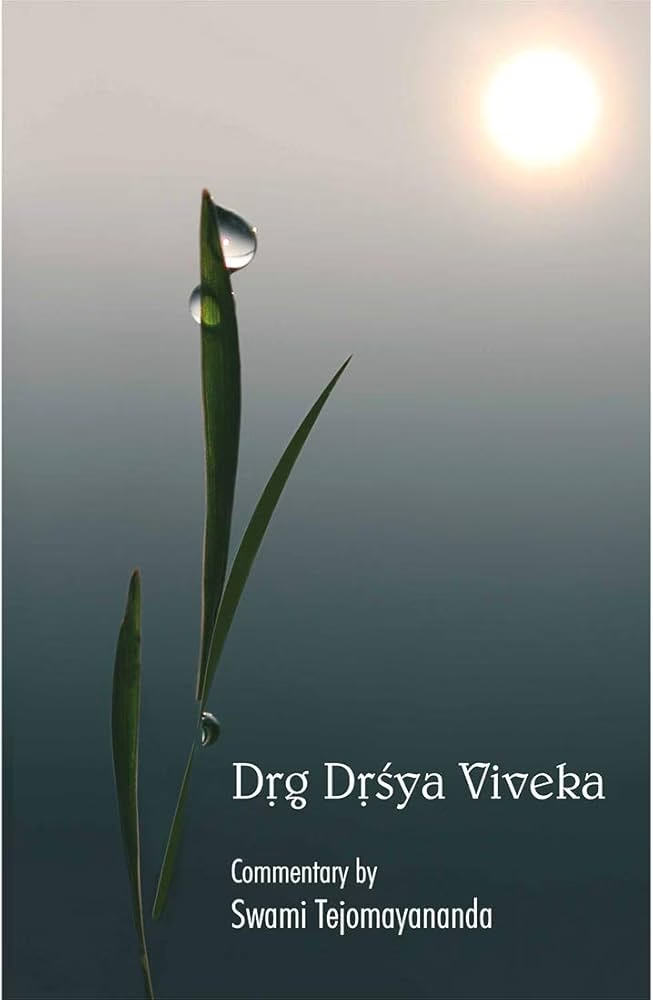
A few days later, a friend mentioned how she listens extensively to Swami Sarvapriyananda’s talks on YouTube, and I thus discovered his many videos online. As I was looking around, I started wondering if I should do an introductory online course on Vedanta Advaita, and I stumbled across this 12-part series of lectures on the Introduction to Vedanta by him. It was based on a slim book of 46 verses called Drig Drishya Viveka, which translates to Discrimination between the Seer and the Seen.
I am not going to go through the book here — firstly, I am not qualified to teach it, and secondly, why read about it second-hand when you can go watch the videos directly? Having said that, I do want to say a few things — after all, that is the purpose of this blog.
To begin with, the title itself is striking. Why does a text on non-duality aim to discriminate between the subject and the object? Isn’t that a reinforcement of duality? Isn’t it better to stay with the emphatic assertion of Krishnamurti:
The observer is the observed
The non-dual teachings begin with our everyday experience of duality — there is a distinct sense of an observer within the body and that which is observed outside the body, which we call the world. They feel distinct and separate and it is not immediately clear how the observer is the observed.
However, the book posits that the observer whom we take ourselves to be is not who/what it seems to be — our understanding of who we are is muddled, and that confusion seems to create this experience of duality.
Anityam, anityam, sarvam anityam
Kshanikam, kshanikam, sarvam kshanikam
Shunyam, shunyam, sarvam shunyam
Dukkham, dukkham, sarvam dukkham– Buddhist chant
Dukkham is not just sadness; it is suffering born out of ignorance (of our real nature). The cure, then, must be the dispelling of that ignorance.
To enable us to come upon the realisation of the non-dual nature of the universe and our true Self (in the singular — spoiler: we don’t each have a separate, individual self), this text begins with our everyday experience of duality and works systematically to demonstrate why this is illusory and how the illusion may be dispelled as a lived experience, not just intellectually.
Here is the translation of the first verse, which encapsulates the entire book:
The form is perceived and the eye is its perceiver.
It (eye) is perceived and the mind is its perceiver.
The mind with its modifications is perceived and the Witness (the Self) is verily the perceiver,
But It (the Witness) is not perceived (by any other).
It goes on to demonstrate that the reality of the universe is nothing but what we truly are, and hence, indeed, the observer is the observed.
I leave it to you to take that journey for yourself if it interests you. The resource is readily available at hand, should you choose to dive into it. Moreover, Swami Sarvapriyananda is a fantastic teacher — his sense of humour, vast knowledge of the scriptures, being well-read on Western philosophy and contemporary writings, and numerous delightful stories make the learning experience truly wonderful. The metaphors appeal immensely to my INFJ-ness. At one point, he says you don’t have to become a monk; you can live your life monk-like, whatever your circumstances.
As for me, this book provided a strong conceptual base and a logical reasoning process to support my understanding of the Direct Path. Now, when I go back to listen to Spira’s guided meditations, some things are much clearer. It also gave me a set of techniques that aid my meditation practice. It did more, but that’s perhaps best not spoken about.
As for the Horcrux vs Hallows dilemma, let’s see how it plays out. On the face of it, there is not much change yet. I have signed up for some salsa classes this weekend, while at the same time, I have started watching the next set of videos on Aparokshanubhuti — a seminal text authored by Adi Shankaracharya.
I have grown up with images of Adi Shankaracharya in the homes of my parents and relatives. I have never been drawn to a ritualistic approach to spirituality and have tended to stay away from exploring the traditional texts. However, there have been echoes from the Upanishads that I have instinctively been drawn to.
I remember very early on, when I was probably 16 years old, someone took me to a talk by Chinmayananda Saraswati (I think). I vividly remember the metaphor of a spider he used to explain how both the efficient and material cause of the universe were identical, and I thought how wondrous is that — both the spider’s magic per se and how it illustrates the deepest truth of our reality! It’s as if there are numerous clues around us. In fact, one could say that everything points to the ultimate truth, but we need the vision to see it. Drig Drishya Viveka provides it.
Years later, I read a book titled Gem in the Lotus by Abraham Eraly, and I was deeply moved by his description of the Upanishads and the mystics who composed that extraordinary poetry. It seemed as if in the midst of all those thick tomes of rites and rituals (which seemed so constraining and meaningless as I grew up), there were indeed some gems, not quite hidden, but certainly needing some effort (and readiness/grace) to discover.
Last year, on my trip to Kashmir, a few months after the Pahalgam incident, I went to the highest point in Srinagar — a Shiva temple built around the site where Adi Shankaracharya spent time meditating — a modest cave structure that you must bow down to enter because the doorway is low (like at my ancestral village home where I was born). I sat there quietly for a while, paid my respects, and asked for blessings. A few other visitors came in, took photos and chatted loudly, and it made me wonder if they missed the point of being in that cave. On the way down the 250 steps, I found a shop with various artifacts. The owner of the shop (an open cart really) was an elderly Sikh paaji, from whom I bought a kada, something I had wanted for a long time. The significance of a kada is that it’s a physical reminder of one’s divine connection and to act rightly.
More recently, I discovered that Adi Shankaracharya had composed my favourite chant learnt at school (mano buddhi ahankara chittani naaham), which is called the Nirvana Shatakam. What an exquisite composition on the neti neti approach — once all that is observable is negated as not me, that which remains is not empty void but fullness — Shivoham Shivoham! Doesn’t it make your skin tingle?
Now, I am studying his text Aparokshanubhuti, which translates to Direct Experience (of the Absolute). I feel a bit like Neo on his training chair for the first time — insatiable.
I did a quick search and found that Adi Shankaracharya lived for 32 years, and he lived it in some kind of uber fast-forward mode, accomplishing extraordinary scholarship, enlightenment and the unification of the disparate spirtual practices within India in such a short lifetime. Stunning!
I wonder: why did so many geniuses die around the age of 32? When I turned 33, I thought I had the definitive proof that genius had escaped me this time around! Makes me think I better live the rest of this lifetime in a manner that continues to give attention to That Which Matters.
Featured Image: Photo by Greg Rakozy on Unsplash