
I know. I know. I know!
It is a silly, sentimental Tamil movie, and I should just let it slide and not write about it here. I watched the movie today, and for some reason, it had an impact. How will I find out what that impact is if I don’t write about it? I could journal privately and leave it there, but then I blogged about Adam & Eve yesterday; if a formulaic Jeffrey Archer novel can get some blog space, so can a mainstream Tamil love story. If I were to look too closely at my motives before writing a blog, then TWM would simply not exist. These pieces write themselves. Who am I to ask why?
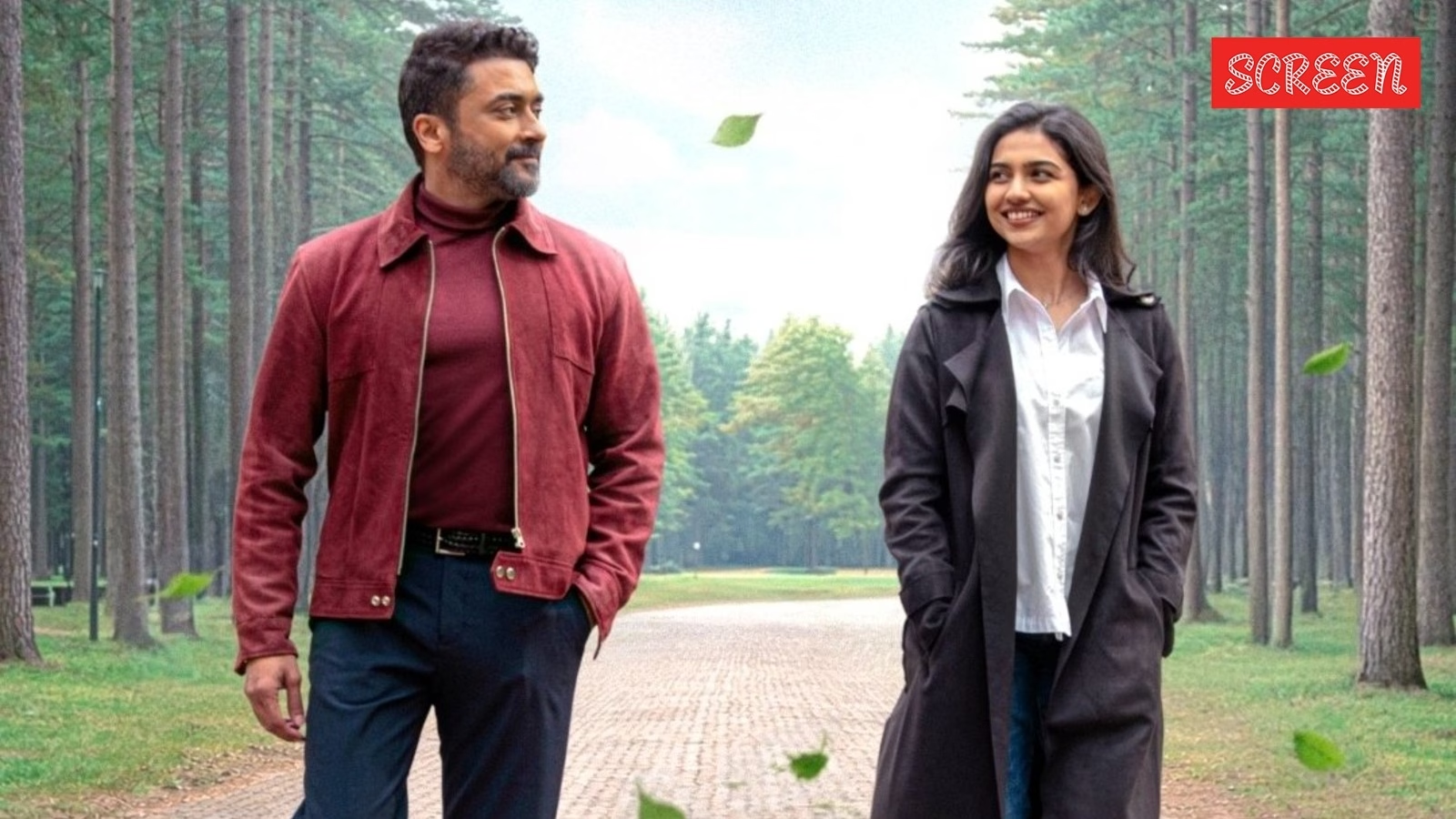
What was the attraction of a movie with such an unimaginative (and slightly deceptive) title: Viswanath & Sons? The two leads — Suriya and Mamitha Baiju. That’s it, really. I had just watched Mamitha Baiju rock it in the Malayalam movie Bethlehem Kudumba Unit a couple of weeks ago — she carried the movie effortlessly with her natural and charming presence. While I was searching for another movie of hers to watch, this Tamil one popped up in the search results.
Admittedly, there is a vast difference between Malayalam and Tamil movies. While the former have mastered the art of storytelling, whether it be romance or whodunits, the latter is often a mess, to say the least. For every ounce of sensibility that Malayalam movies bring to the script, narration, and characters, Tamil movies go the other way — subtlety is simply not their strength. They need to painfully spell everything out — basically, use a sledgehammer where a gentle tap might work. (See, I did it too right there!)
However, it had been a while since I had watched a decent Tamil movie, actually even a rotten one, and this film was doubly attractive because it featured not just Mamitha, but also Suriya — one of the few solid, sensible, and talented actors that recent Tamil cinema has produced. For a long while, in my eyes, that mantle belonged to Kamal, but after Hey Ram, his megalomania made his movies cringe-worthy. Suriya has wisely not strayed down that self-aggrandizing path. He is beginning to take on roles where he doesn’t have to pretend to be twenty years younger than he is, romancing younger women in crude ways. While Suriya has done several great roles, and like Mamitha, has carried entire movies on the strength of his presence, this one song epitomizes why I would more often than not choose to watch a Suriya movie:
In this song sequence, struggling after the untimely demise of his girlfriend in a bomb blast, he gives vent to his heart-wrenching grief. It is the kind of grief that wants you to destroy the world, like what Shiva felt after Sati gave up her body and he erupts into his Rudra Tandav, or anybody else who has struggled to come to terms with an unfair and cruel hand meted out to them by fate. It explodes from the center of one’s being, consuming everything in its path, and finally, with nothing else left to burn, where else can that rage go but inwards? I could totally understand his grief in this song long before I experienced it myself.
When I saw these two gifted actors brought together for a modern-day love story, I decided to watch it this morning, and both of them did a stellar job. While the story and scripting are flawed in several not-so-unexpected ways, and the gifts of Nassar, a once-in-a-generation star, are frankly wasted, the movie lands successfully. Several themes resonated with me.
The first was the contentious idea that while a mother can do everything a father can, the reverse does not hold. While there is some truth to it, and it is a reasonable generalization, I found myself feeling defensive, because my own experience of parenting has been quite different. Besides breastfeeding, which I could not do for obvious reasons, there was nothing else I could not, would not, and did not do. Gender was never a factor. But that response to the movie was just me being prickly; if I ignored my experience, I would more or less agree with the movie’s tenet.
The other part of the movie that landed was the quality of love between Suriya and Mamitha. Each of them was entirely themselves, and there was no attempt by either of them to forcefully change themselves or the other in any way. Each held onto their truth and somehow found a connection. I don’t know if that was thought out carefully by the scriptwriter, but it is a rare dynamic to see. I was taken in by the unstated (and almost unconditional) acceptance of each other’s quirks and faults, and I enjoyed watching both the actors play their parts with wit, playfulness, and patience. One of the unanticipated outcomes of such a relationship, where each can be themselves unapologetically, is that when change happens, as it will inevitably, it is not forced by the other. Watching the possibility of the love of imperfection, where one’s existence is enough, left me wistful because I have not experienced it for myself, and I have longed for it.
What followed after the movie was just as interesting. When you get opened up in some way, then you do things that might surprise you. So I found myself taking some spontaneous initiative this afternoon, and that has interestingly opened up some new possibilities.
It seems to me that every time I resolve to become a full-fledged ascetic and give my energy entirely to spiritual immersion, I get pulled back into this world for another attempt at connection.
Now, like most Tamil movies, I don’t quite know how to end this piece. I suppose I could say more, but would that add much value? Perhaps I should quit without belabouring the point. Ta.