
Question 1
You’ve spoken about a phrase that has stayed with you for 27 years — Do What You Find Most Right To Do. Where did it come from, and what was the context in which you first encountered it?
Transcript
“Do what you find most right to do” is this delightful phrase that is a blast from the past. It’s from a program called The Necessary Teacher Training College, based in Denmark. And I stumbled upon it during a time when I was quite fed up of my PhD in computer science when I was at Wisconsin Madison. And I wanted to travel the world, I wanted to be of service, I wanted to do some social work. And I was like, “What do I do? How do I do this?”.
And then, as has been the theme through all of these episodes in this podcast, one day I was browsing the internet and then out popped this webpage in front of me with a yellow bus which said “Drive a bus from Denmark to India.”. And I was like, “I’m getting on that bus, and I’m going to be driving it.”.
So, fast-forward a few months and I found myself actually part of this program in Denmark. And it’s a four-year program in its design. The first year involved a bunch of us, 26 of us it turned out to be, from 14 different countries from around the world. And I was the only Indian in it.
And we worked for six months to earn enough money to purchase two buses, do up the interiors in terms of bunk beds and a kitchen and a library. And then we drove from Denmark all the way to India and back over a four-month period. The road trip of my life. It was an unbelievable experience and life-changing.
In its design, the second year had what is called the national year. You would stay within Denmark and you would work in Denmark for nine months of the year. And then in the last three months of the second year, you could do what is called “Do what you find most right to do.”. And just like the name of the college itself, I thought it was a delightful name.
It didn’t say “Do what you want.” It said “Do what you find most right to do.”. And that takes a little introspection. What is it that’s right for you to do?. And if you think about it a little bit, I think it will be clear that it really depends upon the context of your life at that particular point in time.
And if I were to think back on it, I would say that the entire process of letting go of my PhD program and getting onto that Denmark bus did feel like the right thing for me to do at that time. Though my advisor was against it entirely and he said, “You know, changes like these need to be an evolution and not a revolution, and you’re making a hasty step and throwing away what is obviously a lucrative career ahead of you.”.
But I’ve never regretted the decision. It’s been the most amazing decision that I took. It required a lot of risk, and well, in my case, it paid off. It could have bombed badly, and the adventure came with its own ups and downs, but overall it turned out to be a great hit.
Unfortunately, the program collapsed after one year, and all those who were part of our batch left. So we didn’t really enter the second year together, and I came back to India. And I really didn’t do the “Do what you find most right to do” as part of that course in that college. But it has remained a guiding philosophy in the background for me, and as I ended the last episode, I really find myself doing what I find most right to do now as well.
Question 2
You were the only Indian on a bus with 25 people from 14 countries, driving from Denmark to India. Four months on the road. What did that journey do to you — and what did it feel like to arrive in India, your own country, as part of that caravan?
Transcript
Being the only Indian on that bus of 14 nationalities felt really special. There were people from, let’s see, Korea, Japan, Portugal, England, US, Denmark of course, Sweden, Finland, South Africa, New Zealand, Slovenia… I don’t know which other country I’m missing out. Just a bunch of really young, idealistic people who wanted to become teachers and make a difference. It was a slightly hippie kind of a culture that was there and with both the ups and downs of that culture. But there were also people who were fairly serious about education and being teachers as well on that group.
Interestingly, Denmark was the first country where I experienced no sense of racism. I didn’t feel that people were looking at my skin; they were just interacting with me as a person. So that was a new experience for me, having lived in England and US for a couple of years each. And in both those places, I always felt that there was a sense of seeing me as an Indian first and then, and then talking to me. So that was a refreshing experience. In fact, in England I had a couple of difficult experiences walking on the road and getting called names and having a coke thrown at me and so on. But anyway, that’s another story.
Learning to drive the bus was the most important thing for me. And I think the experience of that was quite, quite something because learning to drive a car is one thing, but learning to drive a bus is another. And I was learning it along with my Finnish friend, who was like, who took to it like fish to water. He was just at ease driving a bus; it was no big deal for him. And I went around knocking a few lamp posts in Denmark, and my driver was absolutely—sorry, my instructor—was absolutely sure that I would not pass, that I’m wasting my money.
Theory tests that we had to do, and it was in Danish, and it was multiple-choice questions. And since I wasn’t good at the language, or I wasn’t good at learning languages in general, I did what… something quite extraordinary, which was a little out of desperation, which is I simply learned the material by heart and I did pattern matching. And I figured out what the questions were based on what I had seen in the text, and I just matched the questions to the answers, and I got one mark more than my Finnish friend.
So I think that was really a taste of, you know, when I really put my mind to it, I think I just get it done. And that’s come through again and again later in life, whether it is birthing our daughter in Goa or many other instances.
Anyway, coming back to the trip, the journey itself was amazing because I got to see a whole bunch of countries I’d never seen before: Italy, Greece, Turkey, Budapest, Hungary, Romania, Iran. Iran was the surprise for all of us—easily the most hospitable country that we went through, and the one that people were most scared to enter. And given the political situation here today, I think it’s a good reminder for me that the people of a country are different than the politics of a country. And I think we need to be careful not to mix the two up.
I of course couldn’t go through Pakistan because there was the Kargil War at that time and they didn’t give me a visa. So I had to hike back from the border to Tehran and take a flight to Delhi, and I met the rest of my team there, which was an adventure in itself. And I’ve written about all of this in my blog.
There were of course other learnings like for instance, that with a bus that had air brakes, if you keep pumping it, then it’s going to drop below a particular threshold, and it’s not going to work again. And we found this the hard way when we were going downhill in Turkey and the brakes stopped working because it had fallen below the threshold. Luckily it was my Finnish friend who was at the wheel rather than I, and he had the presence of mind to just pull the bus against… to the side of the road against the mountain side and scraped it to a halt. Because when we got down and we saw, it was a long, winding, downhill road all the way, and he saved us that day.
So the trip was full of these kinds of experiences which you can learn only through experience. So I think the bus journey itself was both a metaphor and a lived experience and… and an idea of what transformative education might actually look like. You know, you get out of the school, you get out of classrooms, you go out there, you see the world, you travel together, and you learn from it. I think that’s a fantastic way to learn.
Question 3
You drove a bus from Denmark to India, navigated a war zone, aced a Danish theory test in a language you didn’t speak, and arrived in your own country as part of a caravan of idealistic young teachers from 14 nations. And then the program collapsed. What happened when it ended — and what does a 25-year-old do when the adventure is suddenly over?
Transcript
It is an absolute shame that the program collapsed. I really was looking forward to doing all four years. And, um, financially it just became unviable because the number of people left after the trip, which was really the high point for them. And the burden of managing the finances fell on the few of us who were hoping to complete the program. And it was a self-financing program, and the means of raising funds was quite hard. You had to sell newsletters and flowers on the roads, or some of us had better opportunities in terms of working at a school or working as a chef on a ship. Uh, so there were—it was hard work to raise those funds in order to be able to finance the program. And when the numbers dwindled, it just became unviable after a point.
I was really looking forward to the ‘do what you find most hard to do’ three-month section of the second year, but also the fourth year, which would have involved us going down to either Mozambique or Angola, which were war-torn countries, and to help build schools over there. That was something I was really looking forward to as well, and it didn’t come to pass.
I wrote to my teacher at Rishi Valley School—he was the principal—and he said, ‘Come along and join as a teacher there.’ So that was the plan. And when I came back to Chennai, I visited my other school that I had studied at in Chennai—another Krishnamurti school there. And the principal called me into his office, and he asked me—I’d never met him before, it was the first time I was meeting him—and he asked me, ‘Are you looking for a job?’ And I ended up saying yes, when I wasn’t looking for a job, I was meant to go to Rishi Valley, and that was fixed. And he quickly arranged an interview, and he offered me a job starting at the school in Chennai for a princely sum of 5,000 rupees a month. And he added 50 more rupees because I had a Master’s degree. And I said yes, and that was it. That’s a classic, you know, look left and go right situation over there, and my life changed. And I got married and I lived in Chennai for the next 22 years.
Question 4
You said yes to a job you weren’t looking for, in a city you hadn’t planned to stay in, for 5,050 rupees a month — and it became 22 years of your life. The Rishi Valley plan quietly set aside, the PhD already abandoned. Looking back, do you think you were making choices — or were the choices making you?
Transcript
If I look at those choices, whether it is deciding to homebirth our children – our first child as well as our twins later – or choosing to leave my PhD and go to Denmark on a crazy trip across halfway around the world, or later on deciding to take on a slightly less lucrative job with a journalism college rather than a corporate job at a computer company, these were decisions that people around me thought were hugely irrational, and there were people who pointed that out to me – my brother being perhaps the loudest of the lot.
And being able to take a decision that went against the advice of those close to you was fraught with danger, because you, and you solely, were responsible for the consequences of that decision. Initially, it would impact just me, but later it would impact my family, and so I had to act essentially in the face of fear.
But it didn’t feel like a terribly courageous thing to do; it just felt like the right thing to do. And I don’t have a way to explain what that right thing to do [was] other than as a gut instinct where you just feel a sense of alignment with that decision and your capacity to see the possibility and the potential that that decision had for creativity or adventure or opening up new possibilities. I could see that, and so I trusted my ability based on the potential that it had and a bodily feeling of alignment with that decision.
But I also had other processes in place, so I would do SWOT analysis, for instance. I would put down strengths, weaknesses, opportunities, and threats and work them through from all four angles and see what emerges. And I would start doing things like, “Okay, this is one alternative, this is the second alternative, this is the third alternative; what do they look like?” But at the end of the day, having done all of that analysis, I would set it aside and say, “Okay, now, data aside, what is it that I can live with?” And I would go with the decision that I could live with.
So in a sense, the question that you asked – the answer is both. It did feel like there was a response that came up and me saying “yes” to that situation even in the face of logic, reason, and data, and hence it felt like it was me taking the decision – not just the decision but the consequences of that decision.
And secondly, the decision-making me – yes, through the consequences and having taken the decision, I had to see it through, and it wasn’t always easy. Some of those decisions had a lifetime impact, and one needed to build the resilience to see those through and not second-guess oneself later or feel resentful or doubt the decision itself. Of course, those things came up, but I think having taken so many of them over time, I’ve come to trust this capacity to spot something when it arises and to say “yes” to it and then move with it and then make it happen and then face the consequences if it’s not the way I thought it might turn out to be.
Question 5
You’ve just described a lifetime of saying yes to what felt right — Denmark, homebirths, journalism college, the Chennai principal’s office — each one irrational to others, each one obvious to you. And now at 52, you find yourself saying yes again — to audiobooks, beach cleaning, a podcast, work with AI in education. Same instinct, different decade. What has changed — and what has stayed exactly the same?
Transcript
It’s interesting that when I reflect back on all of these decisions, surrender is actually not a new calling. I’ve um – always said “yes,” I’ve always trusted – even if I’ve doubted myself sometimes – I’ve um – I’ve trusted and surrendered to life again and again and again.
But at 25, you’ve not faced as much loss as you have at 52, so um – there comes the understanding that despite all the losses, there is something that is unbroken in one’s life. And that is not – have to do with the things of one’s life, whether it is, you know, financial stability or any of those things or a home, but um – this deep silence that is our true identity for each one of us, actually.
And uh – resting there gives a perspective on the rest of one’s life that whatever else may happen, that thing remains untouched and unbroken.
So it’s possible that this blog and this podcast may, you know, shut down tomorrow maybe and – for whatever reason – and I’ll – it’ll be sad if that happens. Uh – it’s okay, it’s alright if that were to happen.
But that doesn’t stop me from doing it now. Uh – sometimes there is a foolishness to it, I recognize, to put out all of this in a public domain. But um – that’s what I’m feeling called to do, so I will do it.
The “yes” of today comes from exactly the same place that it came from 25 years ago, except I didn’t know it then and I know it now, and that makes all the difference.
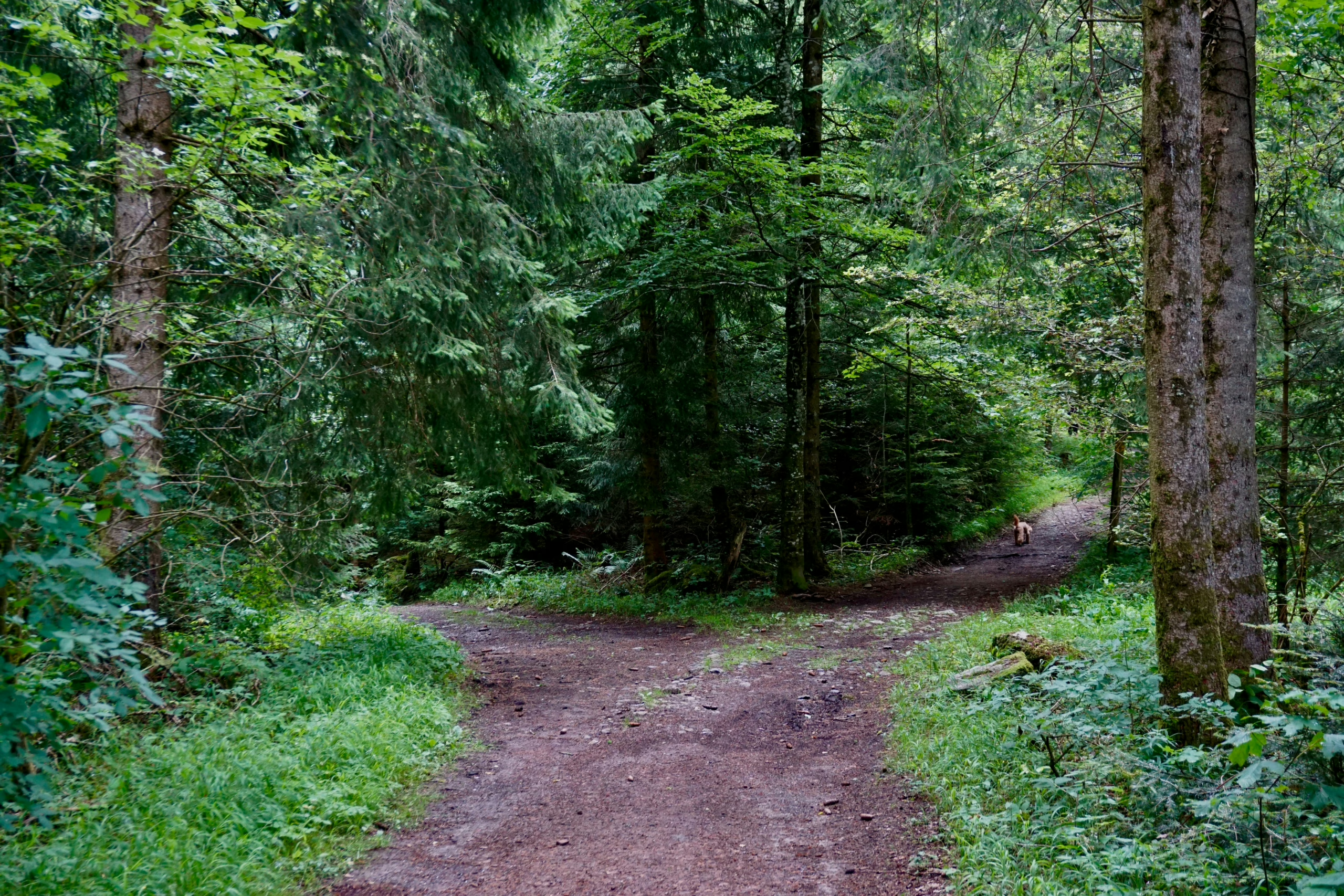
And uh – I will just continue to take the road less traveled.
Season 2: What’s Your Great Cause?
- S2 E1: Do What You Find Most Right To Do
- S2 E2: The Road Less Traveled
- S2 E3: Lessons from Relationships
Related Blog Posts:
- Denmark to India, and Back
- Baptism of a Boy Miss!
- Birthing Without Fear
- Daily Parenting: The First Entry
Featured Image: Photo by Beth Macdonald on Unsplash