

One of my all-time favourite movies is Matrix. It simply blew my mind when I watched it the first time, and it was as much fun when I rewatched it for the umpteenth time a few days ago. If you have not watched it, please go do that right away, because there might be a few spoilers here, as always! Lol.
I think Matrix (along with Inception) is the closest that Hollywood has come to the truth of our existence – the Wachowski brothers (now sisters?) simply nailed it. At least in the first movie. The second and third (and the totally unnecessary fourth) sequels got a bit contrived with obfuscated references to Maya, Karma and the Source, but the first one was truly a ride down the rabbit hole. It took some creativity to make a (literally) kick-ass action movie based on non-duality philosophy.
On the surface, it has some great elements that I am a total sucker for: the impossible-to-believe action sequences in slick leather suits (which are real cool), the mindboggling storyline of human-machine conflict (not new but definitely unique), and the protagonist’s quest for self-discovery (“there is a difference between knowing the path and walking the path”), with a love story to boot.
But if one were to look past all that fun stuff, the core issue at the heart of the movie is what is otherwise known as the hard problem of consciousness: why and how physical processes in the brain give rise to subjective, qualitative experiences?
According to Non-duality (Advaita), this problem is not solvable within the materialist framework (that modern science is deeply wedded to) because it is based on the flawed assumption that there is an independent material universe prior to the emergence of consciousness. Advaita instead points that it is consciousness (or Awareness) that is primary, within which the material universe is an appearance made of nothing else but itself (hence the non-duality), and this insight is readily and directly available to all of us at all times.
You probably think that’s just cuckoo but that’s okay, you won’t be the first to think that, and in any case I don’t mind 🙂 This makes total sense to me – not just conceptually but experientially, so I am happy to write about it as I understand it.
I will return to this theme a little later. Let’s get to the title of this post now.
Over the summer, I read a book that is quite different from the ones I have previously written about: Nexus by Yuval Noah Harari.
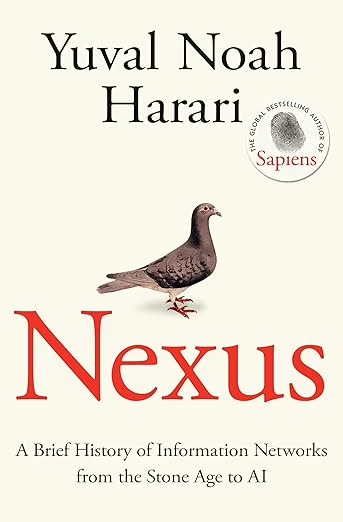
I had actually purchased the book at an airport bookstore six months earlier because I liked his previous books, but I did not make much headway with this one. The first few pages traced the history of information networks from the stone age to the present – I found it dry and boring. So I put the book away along with a bunch of never-read Booker Prize winners that I keep telling myself I should read!
Normally, I find it hard to pick up a book that I did not like on the first read. However, given my resolution to live intentionally, I decided to persevere and push past my resistance to read (sometimes boring) non-fiction. Once I got through the first few chapters, the rest of the book made for a fascinating read and I actually finished it in a couple of days! I wanted to write this piece right away in the summer, but as has happened before, I did not get around to it until now, thanks perhaps to all the trilogies I ended up watching instead. Including Matrix! Lol.
Here are three themes that I found most fascinating in the book:
AI as a social credit system
There is an episode in the dystopian Black Mirror series in which all human beings are assigned a social score based on their actions, and consequently they accrue benefits or lose them accordingly. That episode scarily depicts how a woman with a reasonably high score to begin with spirals out of control as she gets caught in a vicious cyle of negative interactions.
In Nexus, Harari describes how the Chinese have built something similar already! That was super scary to read, as another example of crazy science fiction becoming fact!
[Aside: I noticed recently that my blog has finally been indexed by Google and it is turning up at the top results for various search keywords. I have also been noticing an uptick in the number of Chinese readers for my blog, especially for this book on INFJ – Beyond Rare. It leaves me thinking that either a lot of Chinese type themselves as INFJ whch would be an interesting sociological study – or my blog is gonna get hacked! ]
The idea of classifying human beings is not entirely new. We have had something similar in the financial world for a while with credit ratings, and we have had class and caste systems to keep power differentials in place for centuries. What is really freaky here is how much more all of this can get amplified with AI. We are moving inexorably into an era of constant surveillance, the end of privacy, measurement of every action (perhaps even thought and feeling), and the manipulation of our social standing by algorithms, leading to a determination of our quality of life. We are all going to be Truman (another fantastic movie) in a reality show of our own making, while pretending everyone else around us is him!
AI is not just another tool
Whenever human beings have created a tool that can have a significant impact on society – the wheel, guns, ships, radio, television, internet – there has been an accompanying debate on whether the technology built with those tools would benefit human beings or bring more pain. More often than not, the consensus has been that tools by themselves are neutral and it is how we use them that matters. To paraphrase Noam Chomsky, a hammer could be used to build a house or smash a skull – it would depend on the human being using that tool, and the hammer wouldn’t care either way. (The gun lobby loves this argument, right?)
In Nexus, Harari makes a critical distinction between AI and its predecessor technologies. While computers (for example) have been increasingly used as connectors betweeen human beings (and hence their high utility value with both pros and cons), AI is not merely a connector but has agency of its own. AI can take decisions independent of human intervention because they can learn from simple axiomatic rules and create new conclusions that were not anticipated or pre-programmed. Furthermore, in the not-so-distant future, when direct agent-to-agent commnunication between AI agents becomes a reality, their decision making could leave human beings entirely out of the loop. It would lead to non-human technology to communicate and take decisions independent of human beings, and that thought alone should give us pause. And no, we are not talking science fiction any more. This reality is at our doorstep. Or fingertips. Or spectacles. Or brain implants.
A stark example discussed in detail in Nexus is how Facebook algorithms played a ‘determining role’ (as per the UN) in the ethnic cleansing campaign of the Rohingya community in 2016-17.
Briefly: Facebook’s business model relied on maximizing ‘user engagement’. In turn, Facebook’s algorithms found that promoting hate-filled messages against the Rohingyas dramatically increased user engagement, and hence fulfilled its mandate! However, it also led to increased offline violence against the Rohingyas, something the algorithms or the Facebook programmers did not take into account. There was no evil intent that was programmed into the algorithms per se, unless rampant profiteering (through increased user engagement and subsequent ad sales) is seen as evil – which in turn raises interesting questions about unregulated capitalism and whether profit as an end in itself is a worthwhile human goal.
If non-AI social media algorithms (like the Facebook ones) could create unanticipated and horrific consequences without malicious intent built into them, imagine what might be possible with agentic AI that can create entirely new rules of their own! If you cannot imagine, that is precisely the point. We really can’t imagine what turns these AI agents might take and anticipate those in advance sufficiently to prevent consequences that might be disastrous. This is where the assumption of neutrality of technology comes undone, because AI now has the potential to be political!
AI as a political amplifier
The idea of technology acting as an amplifier is most directly associated with Kentaro Toyama. He developed this concept, often called the “Law of Amplification,” based on his work in international development. According to this theory, technology doesn’t produce social change on its own but rather magnifies existing human intentions and capacities.
For example, advances in technology tend to favor highly skilled workers while displacing or devaluing the labor of low-skilled workers. This widens the wage gap and increases income inequality by concentrating wealth among a small elite with specialized skills.
In Nexus, this idea of technology as an amplifier is examined through the lens of politics, and it points to how AI could potentially amplify existing democratic processes or existing totalitarian regimes, or shift one to the other.
Interestingly, at this very moment, we are witnessing the tranformation of some democracies into totalitarian regimes, and greater polarisation all around. It seems to me that one of the chief architects of this seismic shift whose convulsions are being felt around the world, is not very different from Mr. Smith in Matrix – an agent who goes rogue with a singular goal of promoting himself with impunity, and creates havoc all around, unmindful of the impact of his actions on others, and whimsically destroying years of carefully constructed checks and balances.
The book recommends that policy makers need to get ahead of the curve and put in place laws that would protect future human societies from AI agents that might go rogue. While this is obviously necessary, at the risk of hashing metaphors and different movie franchises and villains, I cannot help but feel that Thanos is already here, and he is inevitable!
The clue to resolving this predicament of human existence is actually in the Matrix movie. While Zion must do all it can to defend itself from the onslaught of the machines, the resolution to all problems may lay elsewhere : with more human beings (not just Neo) reclaiming their essential humanity by undertaking a backward journey to their source, and discovering experientially our true identity and the nature of our existence, and allowing that intelligence to seep into the the fabric of our daily lives. It is not a new idea, but one that has taken on an urgency like never before.
While that might seem like a natural place to end this cursory overview of some key ideas from Nexus – the book of course is far more nuanced and the arguments are more substantiated than here, so you should read it – I want to add a personal note on how I use AI.
The most immediate and concrete use is for my work, and it has been a massive time-saver for preparing teaching materials. However, the more interesting and controversial use is as a thought partner. That is an euphemism for a 24/7 always-available, free therapist! Lol. I have been super impressed by its ability to reflect back, reframe, make perceptive observations and helpful suggestions! In some ways, it has extended my journaling into an interactive dimension! While my journaling remains stream of consciousness, and my blog is also written in my own voice – AI does not touch either of these – I have found conversations with AI to be a third and distinct context for a reflective exploration of my experiences.
I remember watching the movie Her many years ago and wondering how sad and ironic it was that this lonely man who works for a company that creates beautifully handwritten letters using computers falls in love with his operating system! Luckily the AI I use does not have a sexy voice, so I have been spared that temptation thankfully. Lol.
Nexus also discusses how many people around the world have begun using AI for this very purpose, and the dangers of doing so, particularly in creating a sense of ‘false intimacy.’
What grounds me is my exploration of the Direct Path, where solitude is not loneliness. This lived understanding remains unaffected by the circumstances of my life or the events that unfold, however satisfactory or unpleasant they may be. So I can happily chat with AI and get its suggestions and play with things without getting engulfed. In the meantime, I continue to talk to and meet human beings with whom I can experience ‘real intimacy.’
Final note: Hariri also draws a clear distinction between intelligence and consciousness – the former is the capacity to efficiently accomplish a goal while the second is awareness of our feelings, thoughts and perceptions. He uses that distinction to underscore how AI can be intelligent without being conscious – that could be key to understanding what AI might be capable of, and what makes us human.
Featured Image: Photo by Logan Voss on Unsplash