
I came across this book in my Kindle subscription. The title was catchy and timely for me to pause and look at it. Once I started reading, I kept going, until I finished it. Which is a good thing in itself — to complete something one has started.
Never Twice by Vishal Shende is an account of a transformative journey by a young man who stood on the scale one fateful day to see 86 kg staring back at him and how he decided to make changes that would ultimately take him to 68 kg six months later. Without starving, suffering or giving up biryani.
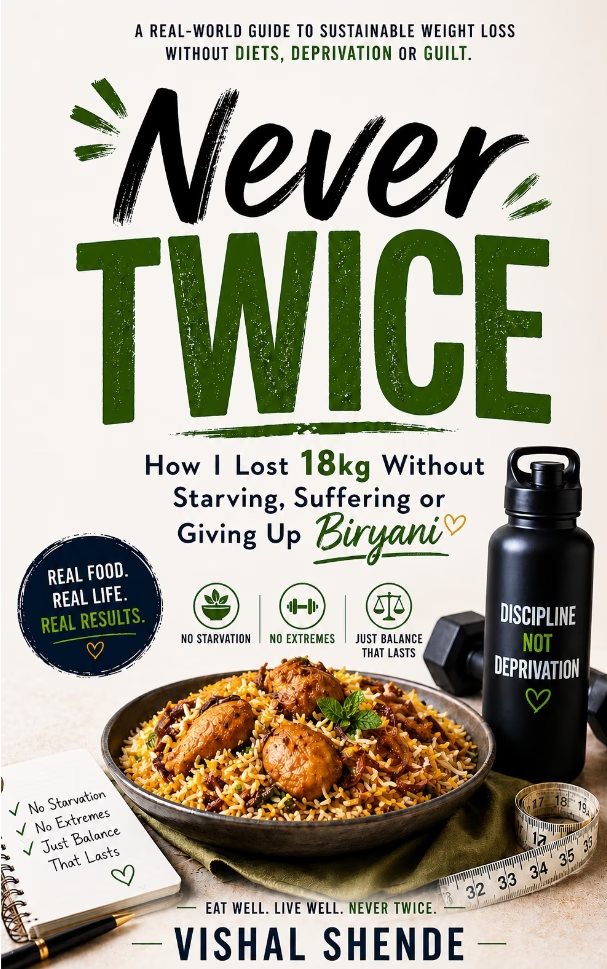
Before I dive into the book, I must say that the language sounds very much like chatGPT — for example, the excessive use of the word ‘honestly’ and the typical AI formulation: not this, but that.
Nevertheless, it was a great read — in fact, I would venture to say that perhaps the use of AI (if any) made it that much more engaging, given how well language models work to put together a coherent document, cleanly integrating personal experience with research.
I have used AI as a thought partner for many aspects of my personal and professional life, and I was really chuffed working with Claude to expand this blog to a podcast.
Personally, I think the use of AI to support one’s creative work doesn’t detract from the message in any way, and the message of this book is too valuable to allow a debate whether or not AI was used in its writing to prevent us from reading it.
The book presents an overall system that is genuinely helpful to those who might want to lose weight in a way that does not feel punishing. What is really atrractive about the book is that while it is seemingly about weight-loss, which it definitely is, the four-pronged system the author has put together can transform our lives in unexpected ways, as you would expect in an interconnected system like mind-body. In the author’s case, it helped him move from a video game junkie to an author and investor.
The four prongs are sleeping, diet, exercise and reading. It is fairly common-sensical and not really novel when it’s listed that way, but the specific interventions he suggests in each of the four areas combined together create a system that has a compounding effect, and one can see why.
Until the age of 40, I never bothered with weight loss — I was slim and I could eat whatever without worrying about weight gain though my exercising grew increasingly intermittent — intense bursts followed by long gaps.
Then the 40s happened. Suddenly, my waistline expanded, and every attempt to start exercising would lead to an injury and an aborted plan. It was also the most stressful decade of my life — both parents passing away after illnesses, juggling two jobs, raising three young children (including twins), taking care of the house, chronic ailments flaring up, selling my mother’s property, purchasing a new one, homeschooling during COVID, brother taking his life — I was run ragged by the end of the decade.
These last few years have given me an opportunity to bounce back a bit, despite serious setbacks continuing to happen on financial, emotional and health fronts. I have written earlier how journaling, exercise and meditation form the triangular base for my life. While journaling has held its ground these four years and happens almost on auto-pilot, exercise and meditation have tended to oscillate. Because exercise is outward-oriented and meditation is inward-directed, the stronger pull in one direction has led to an immersion in that, leading to a temporary diminishment of the other, mirroring the larger conundrum of spiritual versus worldly life. But the oscillations between the two have dampened and the amplitude has reduced, so the yo-yo is less erratic now.
At the same time, a different kind of oscillation has been happening on the weight front. During each of the last two summers, I dropped my weight to 68 kg — though close to the upper limit of my BMR, I was happy with it — only to see the number crawl up inexorably through the school year to around 75 kg. I was sub-73 four months ago and I had recognised that this was my set-point — the weight the body tries to maintain as a hedge against starvation. It is a stubborn point.
I have seen the immediate difference when the weight goes above 73 kg — the cravings increase, portions become larger, the desire to exercise reduces, leading to further weight gain — basically a vicious cycle. Similarly, when it drops below 73 kg, the appetite reduces, I eat less and there is usually a further drop in weight — a virtuous cycle. However, this year, after the health scare early on, my attempts to reduce the set-point to 71 kg just did not work; ironically, I went the other way and put on more weight than ever before! Not sure if the medicines compounded the problem. Seeing 76 kg on the scale had the same impact as 86 kg had on the author — it was a wake up call!
This is the third summer in a row that I am trying to drop back to 68 kg, and this book has given me an integrated approach I can confidently implement to make it more sustainable this time around. A few critical changes such as cooking my own meals and eating slowly are habits that I have struggled with before and am adopting more consistently now.
Returning to the book, here are some key changes in each of the four areas suggested by the author:
- Sleep early and get seven hours daily
- Exercise for an hour in the morning
- Eat up to 80% fullness every meal, following the Japanese philosophy of Hara Hachi Bu
- Replace screen time with reading
These four form an interconnected matrix of habits that reinforce each other, setting in motion a virtuous cycle which makes it easier to keep going because the benefits are there to be seen not just on the weighing scale but, more importantly, how one feels in one’s body and mind. The book discusses each of the four in much more detail.
The lynchpin of this method is the title of the book, Never Twice. While it might be alright to lapse on one day due to unavoidable reasons, it is not okay to lapse twice in a row. This discipline works two-fold: it ensures that what is an accidental miss does not become a pattern; also it works as a deterrent on a day when there’s less motivation — the next day becomes a pressure day because of the non-negotiable Never Twice rule; hence, it might be better to just get up today and do what one has commited to.
The book references other notable works such as Atomic Habits to support the reasoning for the four-fold structure and implementation.
There were other aspects of the book I really liked:
- how he kept his commitment private and did not discuss it with friends or try to change the environment (family in particular), allowing any such changes to happen organically
- how he distinguishes commitment from motivation. “Commitment says: I have decided this is who I am now. Feelings are noted and irrelevant.”
- how his transformation was anchored around a central idea of identity rather than achievement of a numerical goal. He writes, “Real discipline is simply deciding in advance who you are going to be — and then behaving like that person, even on the days you don’t feel like it.”
- how he let go of chai – that has been my bugbear for a while
- how he describes himself as “self-directed by temperament, and works best in quiet rooms without an audience”, which resonates perfectly with the spirit of TWM — a blog written for no one in particular.
So, thanks to the author for sharing his journey and putting together a very practical and useful manual for transforming lives with deceptively ordinary measures whose totality is far more than the sum of its parts. It has definitely helped at least one person. Do read it and see if it helps you as well.