
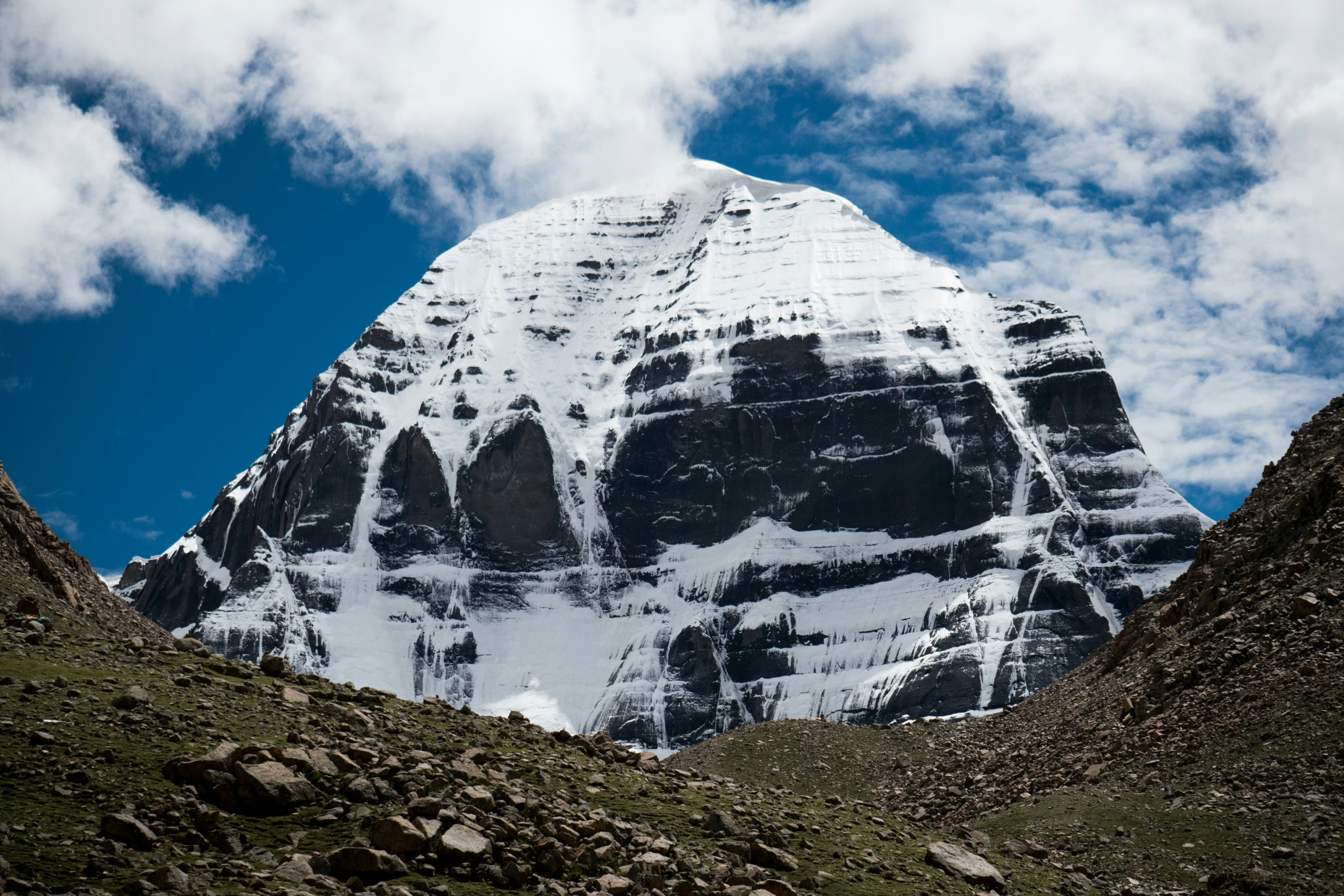
The most unlikely of hymns has become my background score; I am listening to it all the time, on repeat. I first heard it a few weeks ago in a cab in Chandigarh, as I was returning from a short holiday amidst the beautiful Himalayan ranges overlooking the Solang valley, with Hanuman Tibba in plain sight.
The music in the cab was immediately striking, and I asked the driver what he was listening to. I don’t normally initiate a conversation in a cab, or anywhere else for that matter, but I couldn’t help myself this time. He told me the name Namami Shamishan; I looked it up and saved it for later. He said it was very soothing, and I agreed. However, it was more than just soothing; it had an irresistible pull, and now it has taken me over.
Often, I tend to latch onto a single song and play it over and over again for days on end. While I was driving solo from Madison to New York in 1998, it was Jagjit Singh’s Mirage album. It’s a miracle that CD survived the trip. Two years ago, after I watched the theatrical production of the iconic Mughal-e-Azam, I had on loop that extraordinary qawwali Tere Mehfil Mein, contrasting radically differently approaches to love — measured versus surrendered. Later, it was Nusrat Fateh Ali Khan’s Mere Rashke Qamar — an account of a fatally intoxicating encounter with one’s Beloved — punctuated with a delightful refrain: Mazaa Aa Gaya.
So it is not surprising that I am immersed in another song now, but I am wondering: why this one? Is it the deep male voice, which I tend to favour? Could it be the words, which I would have to look up for meaning, just as with most other songs I have liked before? Or is it the rhythm — if so, what about it?
Namami Shamishan are the opening words of the Rudrashtakam, an ancient eight-verse hymn dedicated to Lord Shiva. Growing up, I used to hear many devotional hymns at home such as Suprabhatam, Bhaja Govindam, Kandha Sashti Kavasam, and Hanuman Chalisa. But I never heard this one. Come to think of it, there was not much explicit worship of Shiva at home, other than the use of vibhuti. There might have been a small lingam and a Nataraja idol somewhere. Perhaps there was a good reason why the worship of him was not as visible as that of other gods and goddesses such as Rama, Krishna, Ganesha, or Lakshmi; I imagine the most likely reason is that I was so clueless to observe it, even if it were done.
I have never been drawn to overt religious symbols or ritual worship. But Shiva is something else. He is in a class of his own. Thanks to Amar Chitra Katha, I had read so many stories of him — how he used his third eye to burn whoever had angered him, how he effortlessly captured the rampant Ganga in his locks, and how he contained the primal world-destroying poison by swallowing it. All of them were awe-inspiring stories. He had an aura of someone unapproachable, solitary, wild — the consummate yogi, deep in meditation. You would disturb him only at great peril to your safety. His power did not come from its expression, but in its potential to be expressed. He was totally self-contained, and the embodiment of the highest wisdom. When he was moved to act, it would often be to destroy illusion.
According to legend, even the enlightened Adi Shankaracharya, the original proponent of Advaita Vedanta (non-duality) was tested when he asked a low-caste man (supposedly Shiva in disguise) to move out of his way, and he got the response: Are you asking this gross physical body to move away, or are you asking the pure Atman (Self) within? If it is the body, are not the flesh and the five elements the same in both of us? If it is the Atman, is not that same infinite consciousness present in everyone?
As the story goes, at once realising the gap between his understanding and his actions, overwhelmed with humility and insight, Shankaracharya immediately prostrated before the outcaste and composed the Manisha Panchakam hymn, in which he declared that anyone, regardless of social station, who possesses the realization that the Self is one with Brahman is worthy of being his Guru.
Listening to Namami Shamishan earlier today for the umpteenth time, I finally realised what the magic of the hymn was. It was the damru — Shiva’s drum — beating to the lub-dub rhythm of one’s heart. If the cosmos had a heartbeat, that’s what it might sound like, and here it was, right in one’s chest all the time, barely noticed.
Featured Image: Photo by Raimond Klavins on Unsplash