

Twenty-five years ago, on my first-ever formal self-discovery workshop — one of those where you end up crying at the end despite thinking you are all quite well-put-together — we were asked to draw a self-portrait. I thought I did a swell job, especially given my lack of artistic skills. When it was time to share, I proudly passed around my self-portrait, and the facilitators — you know, the gentle types that challenge your notions with a knowing look — said: you have just a head here, where is the rest of you?
I was utterly nonplussed — not only was my work of non-art not appreciated, but they were pointing out something that should have been blindingly obvious — how did I not draw all of me? Of course, that led to the ‘insight’ that I was essentially living in my head and I did not have the agency of my arms and legs, let alone the warmth and affection of a heart! Uff!
With my later discovery of INFJ personality, I realised that some of us do spend more time in our heads than others, and perhaps it is one of the hazards (and gifts) of that particular personality type.
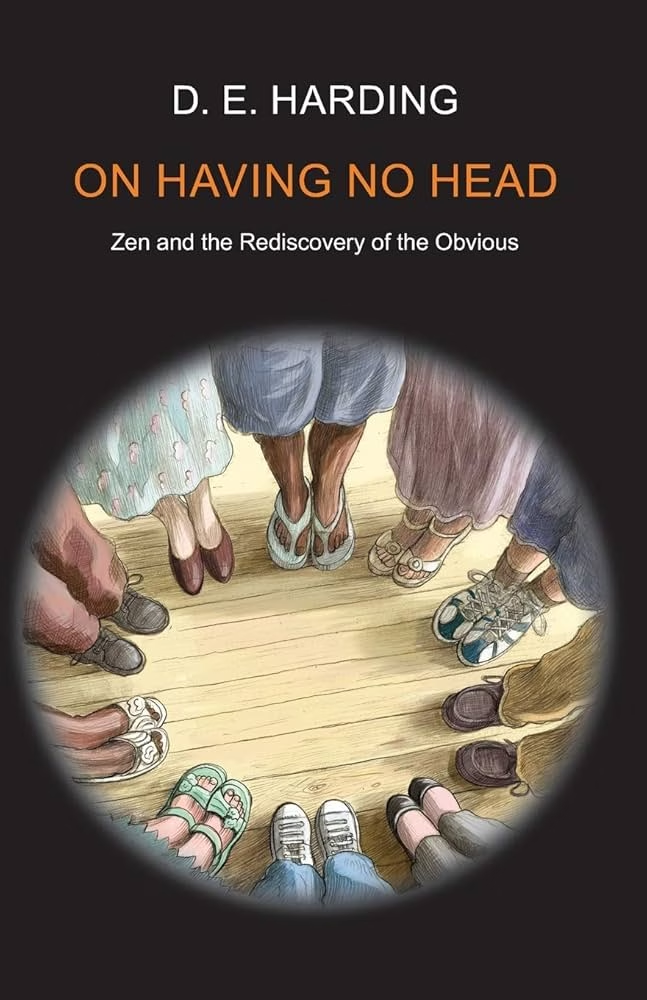
So it is understandable that, after the various spiritual explorations of the last few years, when I stumbled across (like I did with all the other amazing stuff) this book by Douglas Harding titled On Having No Head, it stopped me right in my tracks.
Even after hours (or years) of reading and understanding that one is not a body (or a mind), and experiential meditation that reveals this truth directly, the embodied sense of self is hard to shake off. It needs revisiting several times and repeated dissolving for some of us.
You are not the body. You are the immensity and infinity of consciousness.
– Nisargadatta Maharaj
The assertion that one is headless is particularly startling at first because one can come up with so much evidence against it: we can touch our head with our own hands, we can see it in the mirror, and so many other people can also seemingly see it.
However, if one persists through the objections, the Headless Way literally points to the fact that where one’s head is meant to be, there is Nothing.
And this simple yet powerful finger pointing exercise does the trick beautifully:
And just like that, it is possible to cut off the head of the illusion that we are a separate individual sitting inside a body, looking out into an objective world.
How delightful!
The next time someone points a finger at you, angrily or otherwise, you could ask who’s there (to get hurt), rather than jab a finger back at them.
There are other such useful exercises on the Headless Way – check them out!
Eight Stages of the Headless Way
After describing his own peak experience in the Himalayas, Harding lays out eight stages of what he came to later call the Headless Way — a kind of path that seekers might find themselves on should they take this exploration further:
(1) The Headless Infant, (2) The Child, (3) The Headed Grown-up, (4) The Headless Seer, (5) Practising Headlessness, (6) Working It Out, (7) The Barrier, (8) The Breakthrough.
Here’s a strking image that captures the essence of the first five stages:
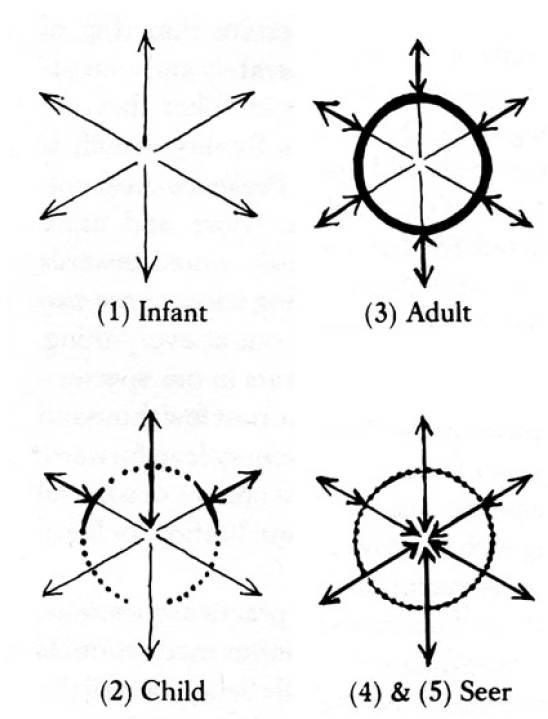
An arrow depticts the direction of our attention.
As an infant, we were utterly unselfconscious, and our attention was entirely outward, overlooking our presence.
As a child, we grew more self-conscious and the arrows turned inward. Some of those inward arrows reached all the way in and we knew our presence directly, while some stopped short because we were beginning to develop a false sense of a separate self (the dotted circle).
As an adult, the circle of the false self has now solidified — there is a distinct sense of me and the world as separate entities — an inside and an outside with the body (and an increasingly swollen head) as the boundary. The arrows now originate and stop at the false self, and the direct experience of one’s presence is veiled.
As a sage (according to Harding), in stages 4 and 5, one begins to be truly Self-conscious again, this time our arrows of attention piercing through the chakravyuha of the false self — the circle now becomes porous but does not disappear entirely.
In his book, Harding walks us through the above five stages and the remaining three as well and we can see for ourselves where we are — not as a signpost of accomplishment (which also is an illusion) but as an honest recognition of one’s understanding and lived experience.
While I was reading the book, I took a break and went to look out of the window at the bright blue sky, the green trees and the birds that seemingly came out of nowhere and disappeared similarly into nowhere. On the window were a set of bars and initially the feeling was of looking out from a prison cell. Then a strange thing happened — the bars separated into a three-dimensional maze of vertical strings, forming a harp-like structure and I was not inside a prison cell anymore. It struck me that we have this remarkable capacity to create depth in our vision. The reality of the world may not be three-dimensional at all, but the ‘camera’ we use to see makes it seem so.
Two Kinds of Mysteries
The part of the book that really struck a chord in me was about the two categories of unknowing that Harding speaks of — a culmination of the path as an alive abiding in the mysteries of life.
The first kind of unknowing:
It is hearing, seeing, smelling, touching things as if for the first time, relieved of the crushing load of time past. It is the revitalizing and extension of our childhood astonishment.
The second kind of unknowing:
Why should existence itself exist?
He goes on to say:
The difference between these two unknowings is immeasurable; they aren’t in the same class. The first sees as miracles the things we are aware of. The second sees as the Miracle the aware No-thing from which they come.
In other words, as move from our childhood wonder of the world around us, through confusing adulthood where we think of ourselves as insignificant and frightened specks in a vast and indifferent universe, to an understanding of what we truly are, we finally come to rest in awe not just of the infinite Universe seemingly out there, but also of it’s infinite Source which is certainly here.
The key to it is minuscule, and it lies in the distance between those little words, what and that. Here, WHAT reality is loses all importance, THAT reality is becomes all-important.
Therein lies the purpose and meaning of our lives — to simply delight in the infiniteness of our capacity, which is simultaneously No-thing and hence, Everything. In the language of Zen, it is the empty cup that can hold water. Obvious you might think, and yet look how so full of ourselves we are!
A good place to start would be to simply lose our heads.
Featured Image: Photo by Rishabh Dharmani on Unsplash